Multiple terms: term1 term2 red apples
returns results with all terms like: Fructose levels in red and green apples
Precise match in quotes: "term1 term2" "red apples"
returns results matching exactly like: Anthocyanin biosynthesis in red apples
Exclude a term with -: term1 -term2 apples -red
returns results containing apples but not red: Malic acid in green apples
hits for
There are no results for your search term.
Network problems
We are sorry, but your search could not be completed due to network problems. Please try again later.
Server timeout
We are sorry, but your search could not be completed due to server timeouts. Please try again later.
Empty search term
You have applied the search with an empty search term. Please revisit and try again.
Too many requests
We are sorry, but we have received too many parallel search requests. Please try again later.
Searching
Volume 389, 2026 | Circular Economy and Technological Innovations for Resilient Water and Sanitation Systems in Africa II
2nd Edition of the C2EA Water and Sanitation Week on “From Research to Innovation and Technology Transfer”, Cotonou, Benin, 3–5 June 2025
Editor(s): Audace Amen V. Dossou-Olory, Aymar Bossa, Ernest Amoussou, Moctar Dembélé, and Gil Mahé
This volume publishes articles from the 2nd Edition of the C2EA Water and Sanitation Week on “From Research to Innovation and Technology Transfer” that was held in Cotonou, Benin, 3–5 June 2025.
It continues the series on “Circular Economy and Technological Innovations for Resilient Water and Sanitation Systems in Africa,” highlighting advances in research, innovative practices, and technology transfer aimed at improving water and sanitation resilience across the continent.
Review process: all papers of this special issue underwent the regular peer-review process of Proceedings of IAHS handled by guest editors designated by the PIAHS chief editor.
Volume 389, 2026 | Circular Economy and Technological Innovations for Resilient Water and Sanitation Systems in Africa II
2nd Edition of the C2EA Water and Sanitation Week on “From Research to Innovation and Technology Transfer”, Cotonou, Benin, 3–5 June 2025
Editor(s): Audace Amen V. Dossou-Olory, Aymar Bossa, Ernest Amoussou, Moctar Dembélé, and Gil Mahé
This volume publishes articles from the 2nd Edition of the C2EA Water and Sanitation Week on “From Research to Innovation and Technology Transfer” that was held in Cotonou, Benin, 3–5 June 2025.
It continues the series on “Circular Economy and Technological Innovations for Resilient Water and Sanitation Systems in Africa,” highlighting advances in research, innovative practices, and technology transfer aimed at improving water and sanitation resilience across the continent.
Review process: all papers of this special issue underwent the regular peer-review process of Proceedings of IAHS handled by guest editors designated by the PIAHS chief editor.
Proc. IAHS, 389, 1–7, https://doi.org/10.5194/piahs-389-1-2026,https://doi.org/10.5194/piahs-389-1-2026, 2026
Short summary
Short summary
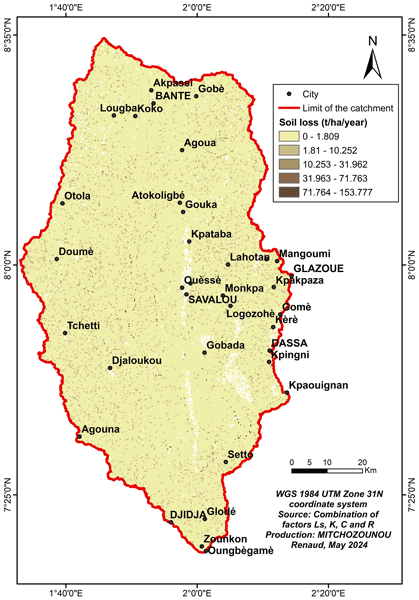
This study focus on maps soil loss in the Zou catchment in central Benin to help protect farmland. Using satellite images, rainfall records and soil data, we identified areas where soil lost is most at risk. Most of the basin shows low soil loss risk, while small zones on steep slopes are more exposed. The results show the important for better land care and future work with higher-resolution satellite data.
Jérôme Enagnon Ahouandjinou, Aymar Yaovi Bossa, and Jean Hounkpe
Proc. IAHS, 389, 9–15, https://doi.org/10.5194/piahs-389-9-2026,https://doi.org/10.5194/piahs-389-9-2026, 2026
Short summary
Short summary
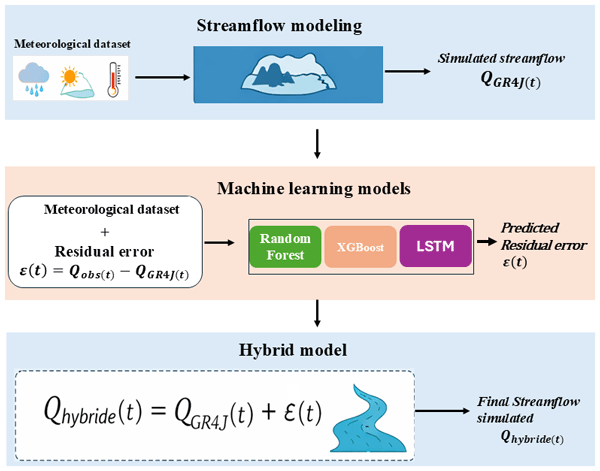
This study aims to improve river flow prediction in a region where hydrological data are limited, which is essential for water management and flood preparedness. We combined a traditional rainfall–runoff model with data-driven learning methods to correct systematic simulation errors. Results show that the combined approach predicts river flow more accurately than the traditional model alone. These findings highlight a practical way to improve water resource planning in data-limited regions.