
the Creative Commons Attribution 4.0 License.
the Creative Commons Attribution 4.0 License.
 | 08 May 2026
Smart management of aquatic environments: application in above-ground fish farming tanks
Yesid Olahonikpèkoun Eriola
Chaim Vivien Doto
Maurel Richy Aza-Gnandji
Ayina Sandra Christelle Boko
Wenceslas Adomou
Gontrand Comlan Bagan
Hyppolite Agadjihouede
Fish farming plays a key role in food security and local economic development in Benin. However, production systems remain largely dependent on manual management practices that constrain productivity, resource optimization, and operational efficiency. This study focuses on the design, development, and functional assessment of a semi-automated above-ground fish tank management system intended for small-scale aquaculture applications. The proposed system is based on a modular low-cost architecture integrating multiple sensors for the real-time monitoring of key water quality parameters, including temperature, pH, dissolved oxygen, and turbidity, along with an automated feeding mechanism and an autonomous corrective control strategy. System control and communication are ensured through a microcontroller-based platform combining Arduino MEGA and ESP8266 modules, while a dedicated web-based interface enables remote data acquisition, visualization, and basic decision support. A functional prototype was developed and evaluated through laboratory and operational tests focusing on system responsiveness, sensor data reliability, communication performance, and control execution. Although no experimental comparison with conventional management systems was conducted, the results demonstrate the technical feasibility and operational stability of continuous monitoring, and automated control under controlled conditions. Overall, the proposed platform offers a scalable, adaptable, and affordable technological framework that lays the groundwork for future large-scale experimental validation and the deployment of smart aquaculture solutions in resource-constrained environments.
- Article
(2037 KB) - Full-text XML
- BibTeX
- EndNote


Fish farming is increasingly recognized as a strategic sector for strengthening food security and supporting economic livelihoods in Benin. According to Pèlèbè et al. (2020), fish farming contributes substantially to animal protein intake and provides employment opportunities in both rural and peri-urban areas. Additionally, Adegbola et al. (2022) emphasize that fish farming helps to reduce reliance on fish imports and mitigates the decline in natural fish stocks caused by climate change, overfishing, and environmental degradation.
Despite its importance, the traditional management of fish farming tanks remains largely manual. Fish farmers must continuously monitor water quality, regulate feeding frequency, and maintain optimal environmental conditions. These tasks are labor intensive and prone to human error. Moreover, the lack of real-time feedback increases the risk of abrupt changes in water quality, which may lead to stress, disease, or mortality among fish populations.
Previous studies highlight the significance of water quality control in aquaculture systems. Verma et al. (2022) note that physicochemical parameters such as pH, dissolved oxygen, and temperature must be strictly regulated to support fish growth and metabolic processes. Similarly, Ogbukagu et al. (2020) show that deviations in these parameters can impair fish physiological functions and reduce production efficiency. Therefore, it is crucial that water quality management practices are rigorously controlled to optimize fish production.
Recent technological advances have introduced the use of Internet of Things (IoT) devices and automated monitoring systems to improve aquaculture management. For example, Ineza et al. (2023) implemented an IoT-based monitoring system in Rwanda to remotely track water quality metrics. Zhang et al. (2011) demonstrated the potential of wireless sensor networks to enhance monitoring accuracy and to reduce reliance on manual measurements.
However, many existing systems focus primarily on data monitoring and notification rather than autonomous intervention. This limitation requires fish farmers to remain constantly available to take corrective action when environmental conditions change. These constraints reduce practical adoption, particularly among small-scale producers with limited technical resources.
To address these challenges, the present work introduces a semi-automated fish tank management system designed to both monitor environmental parameters and perform corrective actions automatically. The system aims to (i) automate feed distribution, (ii) transmit real-time water quality data to a remote interface, and (iii) autonomously regulate environmental conditions within acceptable ranges.
2.1 Study area
The study was conducted in Porto-Novo, the capital city of Benin, located in the southern part of the country. Experimental tests were carried in the commune of Kétou, situated in the southeastern region, at the northern edge of the Plateau Department.
To achieve the objectives of this research, the fish tank was equipped with an integrated set of mechanical, electromechanical, and electronic systems. These were complemented by computer-based control programs designed to optimize the monitoring, regulation, and overall management of the aquaculture process.
2.2 Description of the main mechanical and electromechanical systems
The device is equipped with four mechanical and electromechanical systems, namely:
-
A water supply system that ensures water delivery into the tank;
-
A feeding system that ensures controlled feed distribution;
-
A cleaning and harvesting system that enables tank draining, cleaning, and fish harvesting;
-
A water temperature regulation system that maintains at an optimal temperature for fish rearing.
These different subsystems are illustrated in Fig. 1.
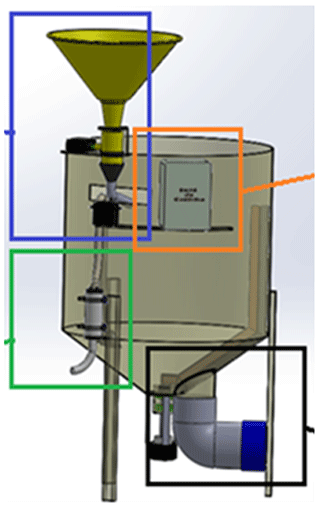
Figure 1Design of the fish tank, showing the different mechanical and electromechanical subsystems. Green box: water temperature control system, blue box: feeding system, black box: cleaning and harvesting system, orange box: electronic control unit.
Each of these systems comprises components that enable it to perform its intended function.
2.3 Description of the electronic control unit
The control unit was developed by integrating multiple electronic components to enable the automation and monitoring of the system's operations. It is primarily centered on two programmable microcontroller boards: the Arduino MEGA and the NodeMCU V3 (ESP8266), which host and execute the control algorithms.
The control unit comprises the following components: Arduino MEGA board, NodeMCU ESP8266 module, DS18B20 temperature sensor, TFT display, 5 V dual-channel relay module, buzzer (alarm), B10k potentiometer, SD card reader, and various jumper wires (male–male, male–female, and female–female) for electrical connections.
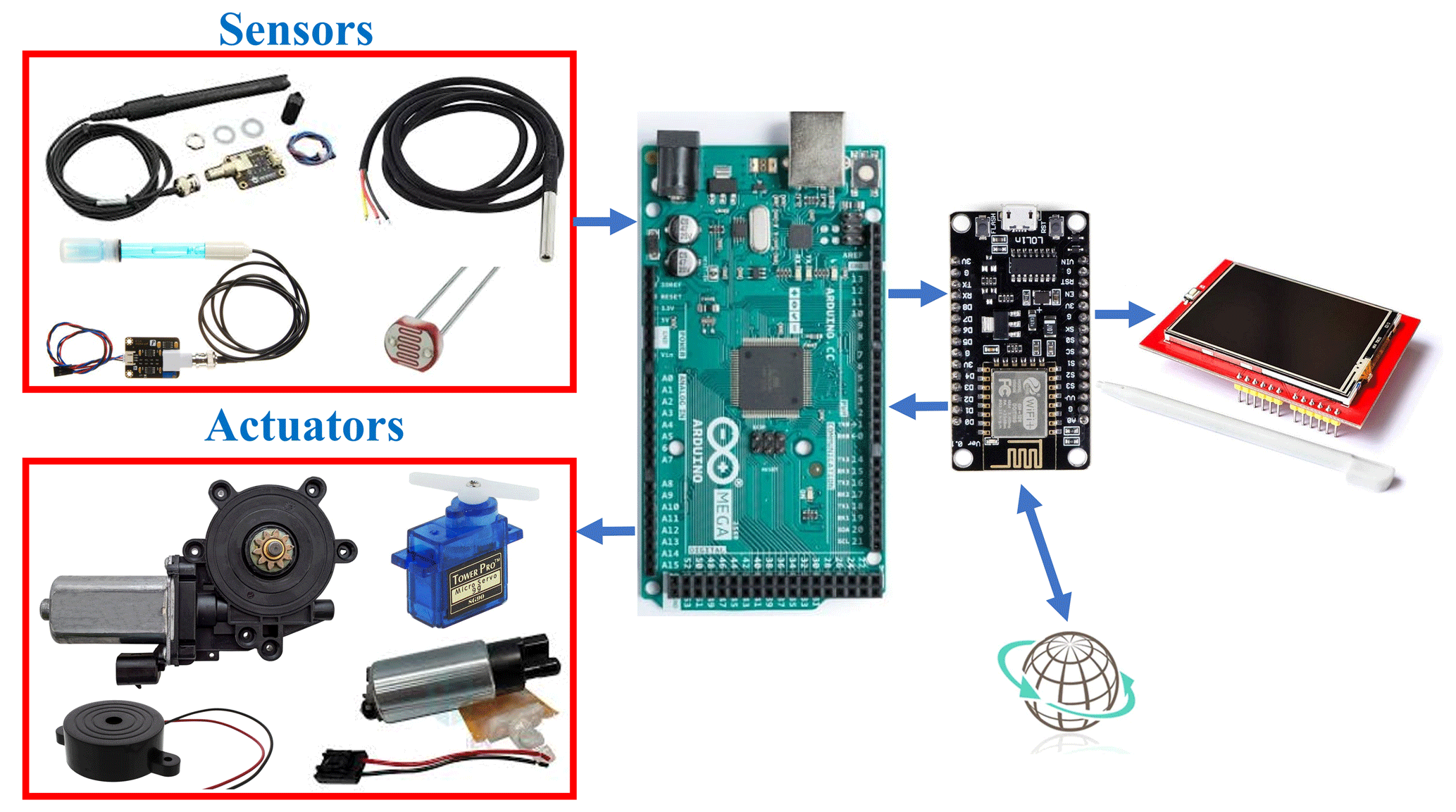
These components are interconnected to support real-time data acquisition, automated control, and feedback display. An overview of the control unit's components and their interconnections is presented in Fig. 2.
The Arduino MEGA reads user-defined parameter ranges from the SD card, controls the feeding system, and responds to sensor inputs. It also transmits the collected data to a NodeMCU ESP8266, which displays the information on a TFT screen and uploads it to a remote database for monitoring and analysis.
2.4 Computer program
Two software systems ensure tank management: a Python/Qt6 tool for parameter configuration and a PHP/JavaScript remote platform for data monitoring and adjustments. Figures 3 and 4 show the configuration interface and a view of historical environmental data.
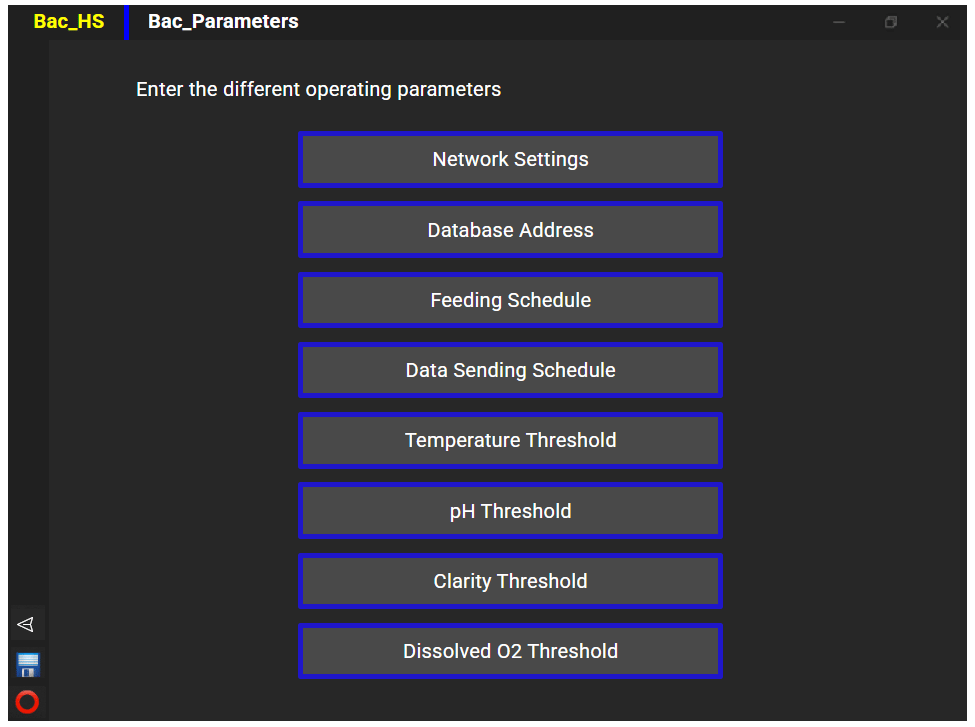
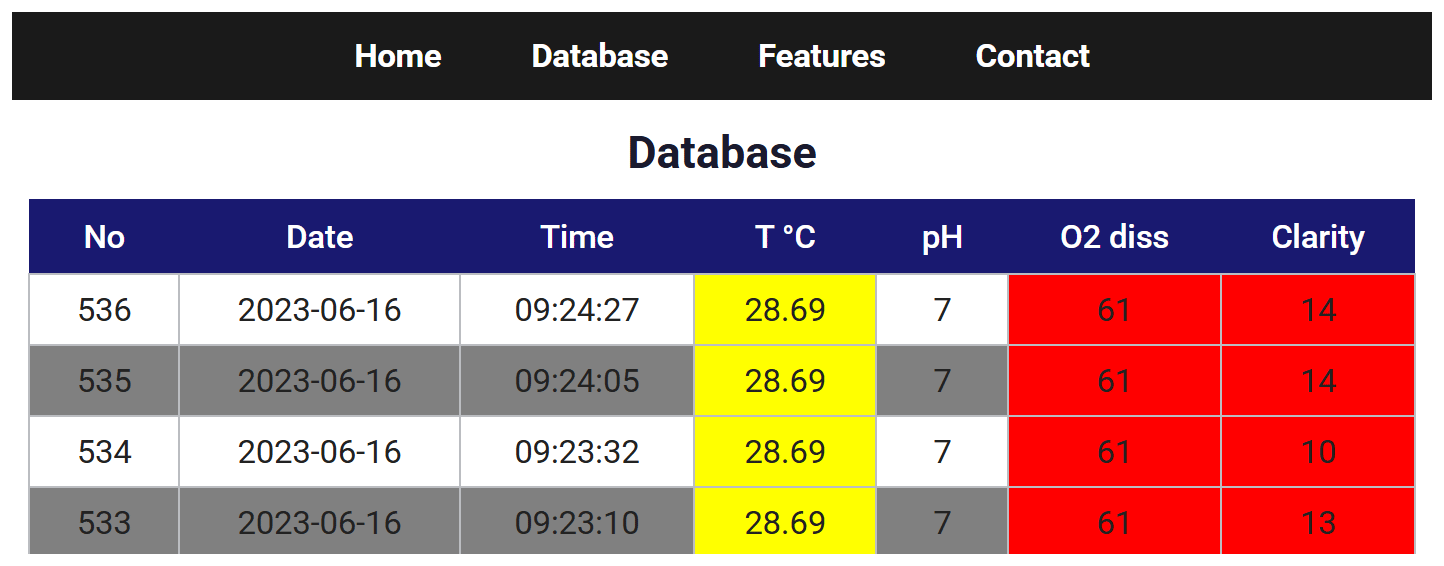
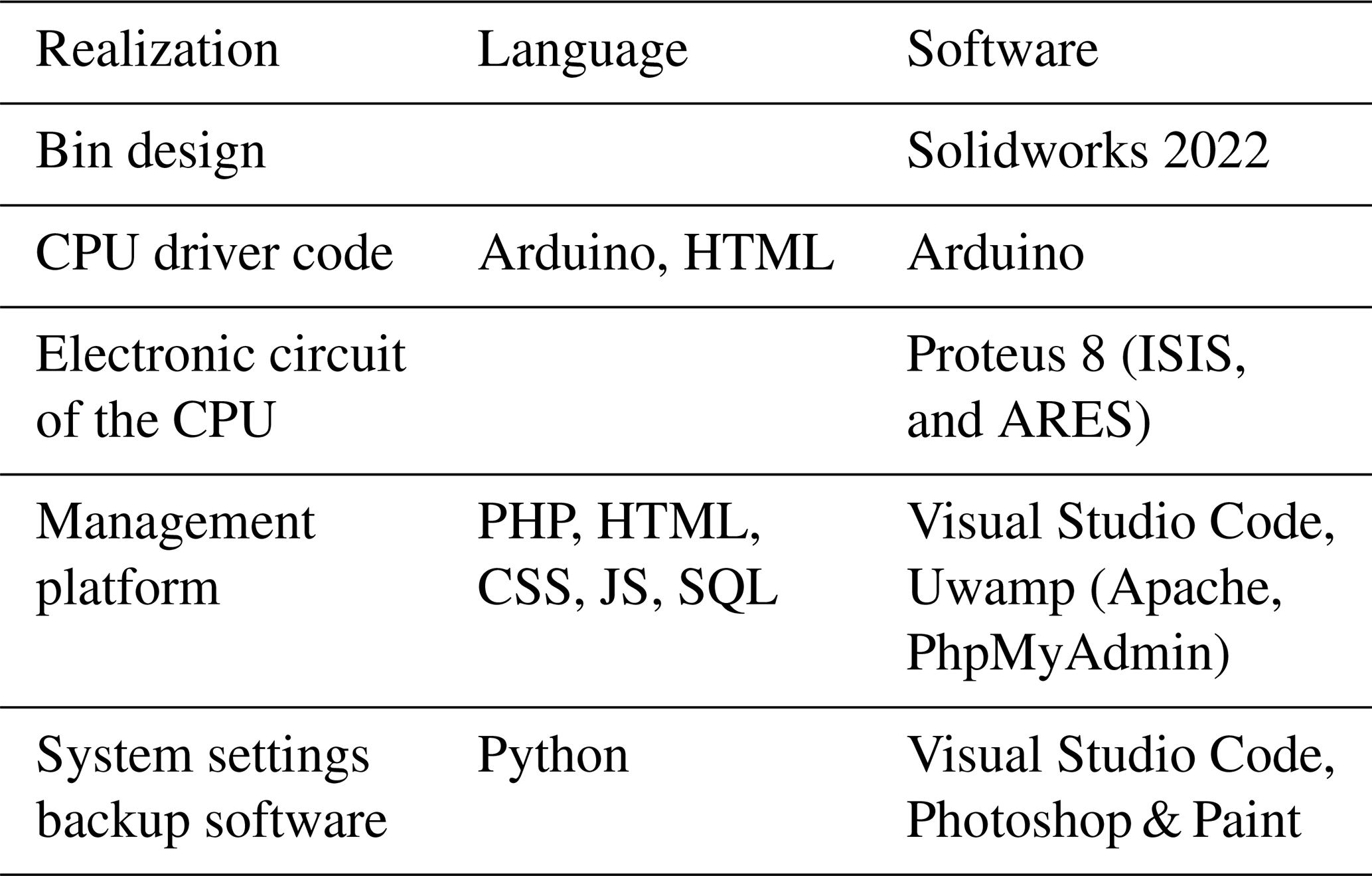
Table 1 summarizes the software tools used.
Table 1Summary of software tools and programming languages used in the projects.
2.5 Prototype testing and validation
During the prototype fabrication, tests were conducted to determine the time required to completely fill the tank, the time to half empty it, and the oscillation angle of the supply pipe, in order to configure these parameters in the Arduino code. To validate the prototype upon completion, the regularity and proper operation of each system were verified.
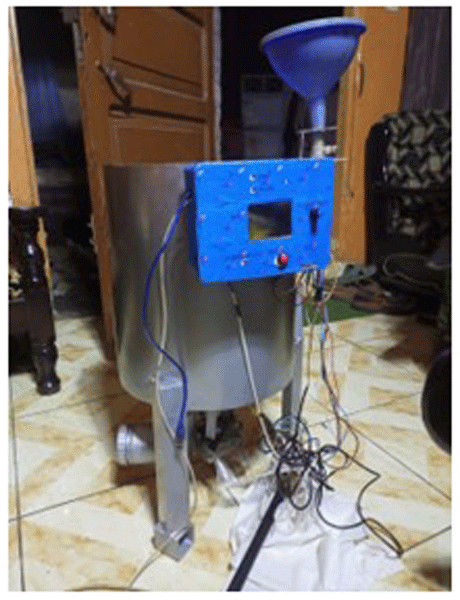
The methodology adopted enabled the development of the smart fish tank and its associated software programs. The tank and the electronic control unit are illustrated in Fig. 5.
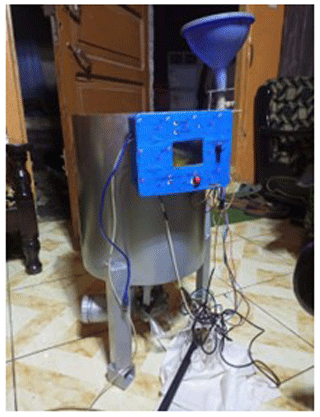
Preliminary tests showed that the tank could be completely filled in 2 min and 30 s, and half emptied in 1 min and 15 s. The system operates according to the configuration stored on the Micro SD card, executing the following automated tasks:
- i.
Real-time display of all monitored environmental parameters on the integrated screen;
- ii.
Scheduled feed distribution according to preconfigured feeding times;
- iii.
Autonomous regulation of water conditions whenever a measured parameter (pH, temperature, dissolved oxygen, or turbidity) deviates from the allowable range defined on the SD card;
- iv.
Automatic transmission of data to the remote database at specified intervals.
This automation of the monitoring and regulation of key water quality parameters represents a significant advantage for fish farm management. By ensuring continuous, precise, and timely control, the system minimizes health risks for the fish, particularly by preventing thermal stress, hypoxia, and extreme pH fluctuations, all of which can have fatal consequences.
Verma et al. (2022) emphasize the importance of physicochemical parameters such as pH, temperature, and dissolved oxygen for fish health. In this context, our device integrates these parameters in a precise and continuous manner, reducing the risks of thermal stress and hypoxia, as also highlighted by Adegbola et al. (2022) in their study on the economic performance of fish farming in Benin.
Moreover, Ineza et al. (2023) demonstrated the effectiveness of IoT-based systems in water quality management for fish farming through automated control of environmental parameters, contributing to improved management and productivity. Our device, however, goes beyond mere monitoring: it actively intervenes to correct deviations, maintaining parameters within admissible ranges, which constitutes a major advantage for the continuous regulation and optimization of fish growth conditions.
The approach developed in our project also differs from that of Zhang et al. (2011). Although both systems use sensors for real-time water quality monitoring, Zhang et al. (2011) rely on a wireless sensor network (WSN) architecture to collect and analyze data via centralized software. In contrast, our device combines continuous monitoring with automatic intervention to directly adjust environmental parameters whenever they exceed predefined thresholds.
Furthermore, the software architecture developed in this project provides enhanced flexibility by combining local configuration software (Python with Qt6) and a remote management platform (PHP, JavaScript, SQL). This dual system allows both direct parameter control via the control unit and in-depth visualization of historical data, facilitating informed decision-making for fish farmers.
Unlike the systems of Zhang et al. (2011) and Ineza et al. (2023) – which primarily focus on data collection and visualization – our solution actively manages the aquaculture environment. This reduces the need for human intervention and significantly enhances the reliability and efficiency of the system.
During the prototype development phase, preliminary tests were conducted to determine key operational parameters, including the time to completely fill the tank, the time for partial emptying, and the oscillation angle of the supply pipe. However, due to the limited time available for the project, full-scale experimental testing and validation under real operating conditions could not be performed. Therefore, the verification process focused on functional checks to ensure proper operation and coordination of each subsystem (water supply, feeding, cleaning, and temperature regulation).
These preliminary assessments provided valuable insights into the prototype's performance, and serve as a foundation for future experimental validation and optimization once sufficient time and resources are available.
The semi-automated management system developed in this study provides a locally adapted solution for small-scale fish farming in Benin, integrating water supply, feeding, cleaning, temperature regulation, and electronic control. Each subsystem operates autonomously in response to real-time environmental parameters, ensuring optimized tank management and minimizing health risks such as thermal stress, hypoxia, and extreme pH fluctuations.
The main contribution of this work is the demonstration of a fully integrated, accessible prototype that combines continuous monitoring, automated feeding, and autonomous regulation. Preliminary functional tests indicate enhanced environmental stability, reduced labor requirements, and improved conditions for fish health. However, full-scale experimental validation on fish growth and production yield has not yet been conducted, representing an important avenue for future research.
Future developments will focus on integrating renewable energy sources, implementing predictive water quality management, and incorporating closed-loop recirculation systems to further enhance the sustainability and productivity of small-scale aquaculture operations.
The underlying software code is not publicly accessible at this time, as the system is still under active development and refinement for future deployment. The code may be made available upon reasonable request to the corresponding author.
The datasets generated during this study consist of raw sensor readings and operational logs collected during prototype testing under controlled laboratory conditions. These data are not deposited in a public repository as they are specific to the experimental setup described in this paper and require contextual interpretation. The data may be shared upon reasonable request to the corresponding author.
YOE and WA conceptualized the project, designed the methodology, fabricated the prototype, and conducted functional experiments. YOE prepared the initial draft of the paper. CVD contributed to writing, revision, and supervision. MRA provided technical supervision, and assisted with the paper review and editing. ASC reviewed and edited the paper. GCB and HA provided overall supervision, scientific guidance, critical review, and final validation of the article.
The contact author has declared that none of the authors has any competing interests.
Publisher's note: Copernicus Publications remains neutral with regard to jurisdictional claims made in the text, published maps, institutional affiliations, or any other geographical representation in this paper. The authors bear the ultimate responsibility for providing appropriate place names. Views expressed in the text are those of the authors and do not necessarily reflect the views of the publisher.
This article is part of the special issue “Circular Economy and Technological Innovations for Resilient Water and Sanitation Systems in Africa”. It is a result of the first edition of the C2EA Water and Sanitation Week on the Circular Economy and Technological Innovations, Cotonou, Benin, 3–6 December 2024.
The authors acknowledge the School of Rural Engineering (EGR), National University of Agriculture, for their institutional support throughout this work.
This paper was edited by Ernest Amoussou and reviewed by Simon Ahouansou Montcho, Ernest Amoussou, and Pascal Breil.
Adegbola, Y. P., Crinot, G. F., and Arouna, A.: Fish farming systems diversity and implications in the Republic of Benin: Fish farm types and their economic performance. Aquaculture, Aquacult. Fish Fish., 2, 522–539, https://doi.org/10.1002/aff2.79, 2022.
Ineza, Y., Madson, G., Innocent, I., Claude, H., Maximillien, N., and Gedeon, B.: IOT Monitoring Systems in Fish Farming Case Study: “University of Rwanda Fish Farming and Research Station (Ur-FFRs)”. Eur. J. Technol., 7, 43–61, https://doi.org/10.47672/ejt.1559, 2023.
Ogbukagu, C. M., Anaukwu, C. G., Ekwealor, C. C., Mba, A. N., and Ekwealor, I. A.: Physicochemical and Antibacterial Susceptibility Profile of Fish Pond Waters in Anambra State, Nigeria, Am. J. Microbiol. Res., 8, 150–159, https://doi.org/10.12691/ajmr-8-4-5, 2020.
Pèlèbè, O. E. R., Toko, I., Ouattara, I. N., Attakpa, E. Y., and Montchowui, E. H.: Fish farming in existing water bodies: Techniques and species of interest in Benin, Rev. Maroc. Sci. Agron. Vét., 8, 465–471, 2020.
Verma, D. K., Singh, S., Maurya, N., Kumar, P., and Jayaswal, R.: Important Water Quality Parameters in Aquaculture: An Overview, Agric. Environ., 3, 24–29, 2022.
Zhang, M., Li, D., Wang, L., Ma, D., and Ding, Q.: Design and Development of Water Quality Monitoring System Based on Wireless Sensor Network in Aquaculture, in: IFIP Advances in Information and Communication Technology, vol. 347, Springer, Berlin, https://doi.org/10.1007/978-3-642-18369-0_76, 2011.